
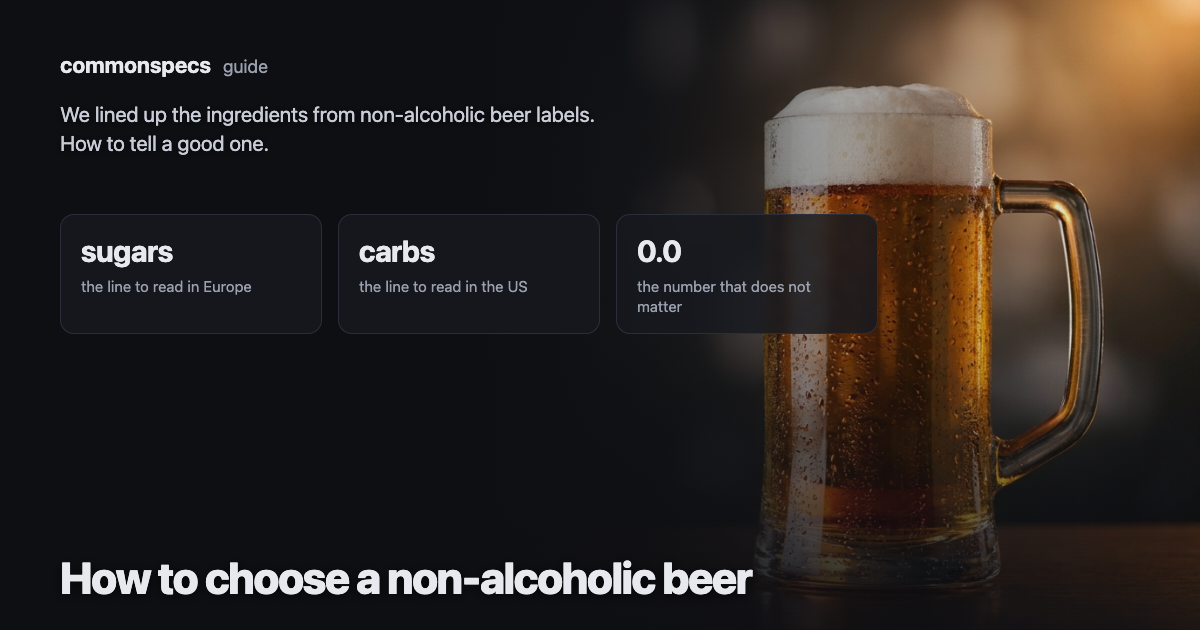
How to choose a non-alcoholic beer
Zero is not the number that matters. The front of a 0.0 can tells you nothing useful.
The back tells you everything — but the line you need flips at the Atlantic: sugars in Europe, carbs in the US.
Calories come from carbs here. The good one has no flavourings, and no list does not mean none.
Flavour should come from the brew, not from added sugar. None beats natural beats synthetic.
Same chemistry, different paperwork. With the alcohol gone, the leftover carbohydrate is both the calories and the fingerprint of how the beer was made. America files it under carbs per serving. Europe prints it as sugar per 100 ml.
The first mark of a good one is the same on both shores.
Beer flavour is built in fermentation, out of four things: water, malt, hops and yeast. Taking the alcohol out strips part of that away. A flavouring further down the ingredient list is a patch, an attempt to rebuild what the process removed. So the list, not the number, is where to start on either shelf.
On the US shelf the split runs between the brewers who print a list and the ones who do not.
Corona Non-Alcoholic, Budweiser Zero, Michelob Ultra Zero and Stella Artois 0.0 publish no ingredient list we could find, in the shops or on their own pages.
Europe prints the list by law, so the same split shows up inside it instead — and it is worth reading against the sugar figure rather than after it.
Zero sugar with a flavouring on the list is not the win it looks like. Taste and aroma are carried by malt, hops and yeast. A flavouring means the taste was not built by the raw materials alone.
In the US, no ingredient list does not mean no flavourings.
The silent brands are breaking no rule. A dealcoholised beer made from malted barley and hops is a malt beverage, and its label sits solely with the alcohol agency, which asks for a brand name, a class and type, the producer and address, the volume and a handful of specific warnings. An ingredient list is not among them. The food rules that would force one — including the rule that an artificial flavouring must be named as artificial — reach only drinks that fall outside the malt beverage definition.
The split is an artefact of 1935. The post-Prohibition act that handed beer labelling to the alcohol agency set no minimum strength, so a 0.0 brewed from malt and hops inherits the lighter rulebook. Take the hops out and the same drink would have to disclose more.
Which leaves three rungs to read, in this order:
- A full list with no flavouring on it — the strongest signal on the shelf. Printing the list is voluntary, but a printed list may not leave out an added flavouring, so the absence is binding.
- A list that names a flavouring — the taste was rebuilt after the alcohol left. “Natural flavor” does not say what it was made from.
- No list at all — no information, and perfectly legal.
A brewer with something to hide does exactly what the rules allow: prints nothing. Which is why a full printed list is worth more than the word natural sitting on it.
In Europe the label must name them, and it must say which kind: a “flavouring” and a “natural flavouring” are different words on purpose. That is the one place the European shelf tells you more, and it is why the ladder above collapses to two rungs there.
“Non-alcoholic” is a legal line, not zero.
If you avoid alcohol for health, for pregnancy or out of belief, that gap is the one thing the shelf never shows you.
Skip added sugar and sweeteners.
Glucose syrup, fructose or stevia in a plain lager means the body of the beer was dosed back in once the alcohol came out. Guinness 0 says so outright, with fructose on the list. Juice is another matter: in a fruit beer the sugar is the style rather than a patch. Only the list separates the two — fruit pulp yes, glucose syrup no.
On the European shelf, where the figure is printed, both cases are visible at once.
Two of these carry more sugar than the others and only one of them was sweetened. Read the list, not just the number.
Now the US, where the sugar line is nearly useless.
US Nutrition Facts panels on these cans run in the short format: calories, fat, total carbohydrate, protein. The sugar line usually does not appear at all. We read sixteen labels across the category and one broke out sugars — Lagunitas IPNA, which publishes a full panel on the brewery's own page, 3 g per 12 fl oz.
There is a reason the panel runs that short, and it is the same reason as the missing ingredient list: alcohol law asks for no nutrition panel either. And where a sugar figure does appear, the rounding blunts it. Under 0.5 g per serving prints as 0, and under 1 g need not be declared at all. A can that says 0 g of sugar and a can that says nothing can hold the same beer.
The line that does move is total carbohydrate, and every can carries it.
With the alcohol gone, the carbohydrate is where the calories come from. Across every US pair we checked, kcal runs at roughly carbs times four. One number, read once, tells you both.
The serving-size trap.
The US panel is per serving, and servings are not the same size. Two of the cans above pour 11.2 fl oz rather than 12, and a Guinness 0 can pours 440 ml. Per 100 ml, Heineken 0.0 and Corona Non-Alcoholic land within 0.1 g of each other, and a stout that reads heavier per can turns out lighter per glass. Normalise before you rank, or the packaging does the ranking for you.
Credit where the label went further than it had to.
Lagunitas publishes a full panel with sugars, IBU 20 and ABV to two decimals. Guinness gives complete values per 100 ml, the ingredient list, and is the only brewer in this whole set to name its method on the label: “gently removing the alcohol through a cold filtration method”.
Athletic Brewing is the sharpest case. Run Wild carries the same six items on the can in the US and on the shelf in the UK — water, malted barley, oats, hops, wheat, yeast — with no flavourings, no sweeteners and nothing dosed back in. In Britain the law demands that list. In the US nothing required them to print a word of it.
You do not have to memorise any of this.
Every figure above comes from a label or a brewer's page, and each one is recorded in commonspecs with the source behind it. That is what the database is for: your agent reads it and helps you pick the right products and services from the offers available where you are.
If we missed a 0.0 worth adding, tell us. It goes into the database and serves the next person standing in front of the cooler.